Solar Power Plant Design: The Complete Engineering Guide (2026)
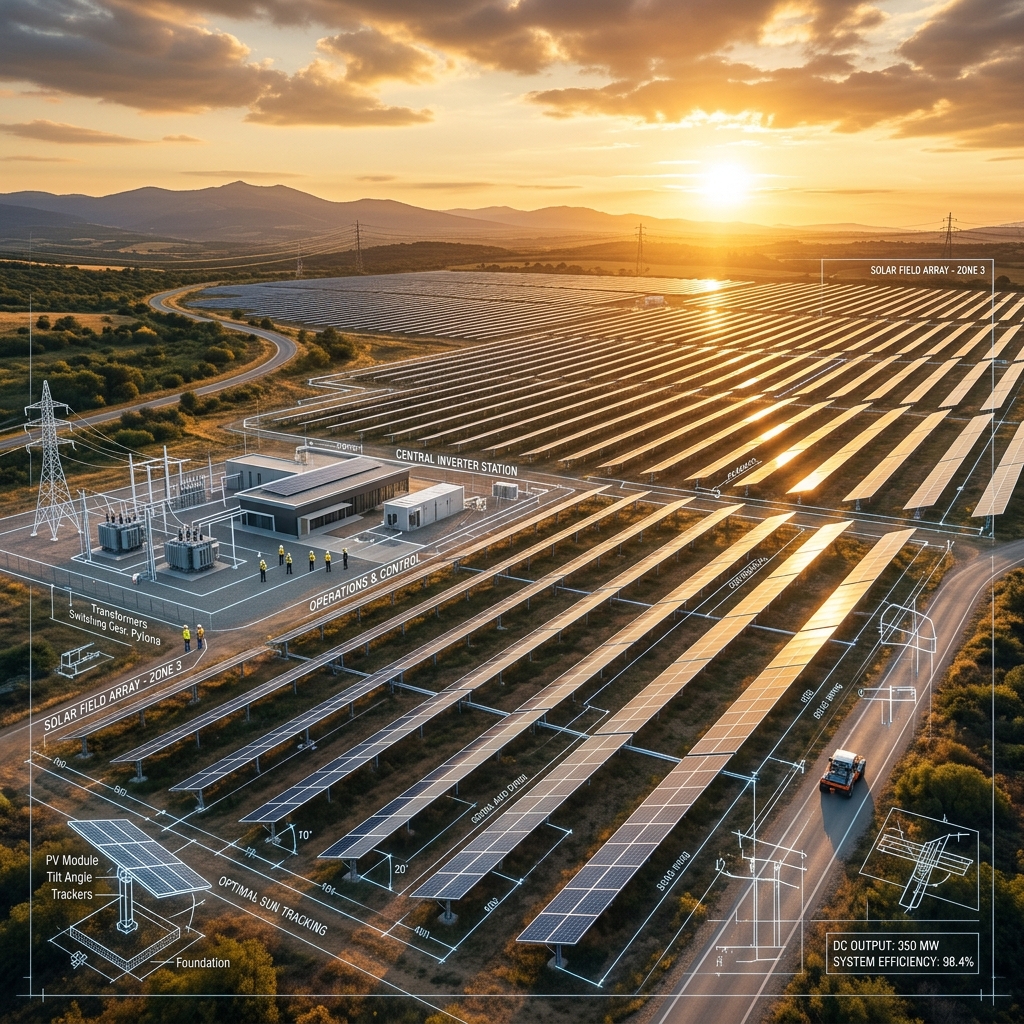
India is racing toward 500 GW of renewable energy capacity by 2030 — and solar power plant design is the invisible backbone making that ambition real. Before a single solar panel is installed, a rigorous engineering process determines whether a plant will deliver on its energy promises for the next 25 years — or quietly underperform, costing developers and investors crores in lost revenue.
This guide covers everything you need to know about solar power plant design in India: the five engineering phases, key design parameters, applicable standards, common mistakes, and what separates a good design from a great one. Whether you’re a solar developer, an EPC company, a C&I energy manager exploring open access solar, or an investor evaluating a project, this article gives you the technical foundation to make informed decisions.
What Is Solar Power Plant Design?
Solar power plant design is the comprehensive engineering process of planning, calculating, and documenting all technical aspects of a solar photovoltaic (PV) system — from site assessment and electrical layout to civil structures, grid integration, and detailed construction drawings — before physical installation begins.
The design process spans multiple engineering disciplines: electrical, civil/structural, and power systems engineering. The output is a set of detailed engineering drawings, simulation reports, and specifications that guide the construction of the plant and serve as the legal and technical basis for EPC contracts, lender approvals, and grid connectivity applications.
At its core, good solar power plant design answers three fundamental questions:
- How much energy will this plant produce? (PVsyst simulation, yield analysis)
- How should the plant be built? (electrical, civil, and structural drawings)
- How will the plant connect to the grid safely and reliably? (power systems studies)
The 5 Phases of Solar Power Plant Design
A well-structured solar power plant design follows five sequential phases:
- Phase 1 — Feasibility & Site Assessment: Evaluate whether the site can support a viable solar project.
- Phase 2 — Electrical Engineering & Solar PV System Design: Design the complete electrical infrastructure.
- Phase 3 — Civil & Structural Engineering: Design foundations and mounting systems.
- Phase 4 — Detailed Engineering & Documentation: Produce construction-ready drawings and specifications.
- Phase 5 — Power Systems Studies & Grid Integration: Ensure safe, compliant grid connection.
Phase 1 — Feasibility & Site Assessment
Every solar project begins with a thorough feasibility study. This phase answers the foundational question: Is this site, in this location, at this scale, commercially and technically viable?
Solar Resource Assessment
The first step is quantifying the solar resource using Global Horizontal Irradiance (GHI) data. India enjoys some of the world’s highest GHI values — ranging from 4.5 kWh/m²/day in the Northeast to over 6.5 kWh/m²/day in Rajasthan and Gujarat. Engineers use satellite-derived data (Meteonorm, NASA POWER, PVGIS) or ground-measured data to create a Typical Meteorological Year (TMY) dataset for the site.
Land & Topography Assessment
Engineers evaluate terrain slope (ideally ≤ 5%), shading sources (trees, buildings, adjacent structures), soil bearing capacity, and drainage patterns. Flood risk assessment is essential for sites near water bodies — a requirement often overlooked until it’s too late.
Grid Feasibility
A solar plant needs a grid connection px-deliver power. The feasibility study maps the distance to the nearest substation, available evacuation capacity, required voltage level (11 kV, 33 kV, 132 kV), and approximate transmission cost. In India, grid feasibility varies significantly by state and DISCOM jurisdiction.
Phase 2 — Solar PV System Design: Electrical Engineering
This is the core of solar PV system design — translating the energy goal into a detailed electrical architecture.
Solar Layout Design & String Configuration
The electrical layout begins by determining the optimal panel arrangement: row orientation (typically south-facing in India), tilt angle (optimised for GHI and inter-row shading), and row-to-row pitch. String configuration defines how many modules connect in series per string and how many strings connect in parallel per combiner box — directly affecting the system voltage, current, and inverter compatibility.
Single Line Diagram (SLD)
The Solar Single Line Diagram is the master electrical drawing of the plant. It shows the complete power flow path: from PV strings → combiner boxes (DCDBs) → inverters → LT panel → transformer → HT switchgear → grid connection point. The SLD is required by DISCOMs for grid connectivity approval and by CEA regulations for solar installations above 1 kW.
Solar Cable Sizing Calculations
Every cable in the system — DC string cables, DC main cables, AC feeder cables, HT cables — must be sized for:
- Current carrying capacity (rated current with derating for temperature and grouping)
- Voltage drop (typically ≤ 1.5% for DC strings, ≤ 2% for AC feeders)
- Short circuit withstand capacity
Phase 3 — Civil & Structural Engineering
The physical infrastructure of a solar plant is as important as the electrical design. Civil and structural engineering determines whether the plant survives wind, seismic activity, and the test of time.
| MMS Type | Description | Best For |
|---|---|---|
| Fixed Tilt | Set at optimal tilt angle, no movement | Most ground-mount plants in India |
| Seasonal Adjustable | Manually adjusted 2–4 times per year | Sites with high seasonal irradiance variation |
| Single-Axis Tracker | Tracks sun east-to-west daily | Large projects where yield gain justifies cost |
STAAD Pro structural analysis is used to validate that the designed MMS can withstand all applicable loads including wind load per IS 875 Part 3 and seismic load per IS 1893.
Phase 4 — Detailed Engineering & Documentation
Once concept design is approved, detailed engineering produces the full package of IFC (Issued for Construction) drawings that govern actual construction. This includes electrical IFC drawings, civil IFC drawings, equipment specifications, and a detailed Bill of Quantities (BOQ).
Phase 5 — Power Systems Studies & Grid Integration
Connecting a solar plant to India’s grid requires satisfying both technical and regulatory requirements. Power systems studies demonstrate that the plant can be integrated safely without destabilising the local grid.
Common Mistakes in Solar Power Plant Design
- Skipping proper 3D shading analysis: Underestimating inter-row or near-object shading causes 3–7% overestimation of yield.
- Undersizing AC cables: A 1% extra voltage drop across a 25 MWp plant costs ₹15–20 lakhs per year in lost revenue.
- Setting soiling losses too low: India’s dust levels demand 3–5% soiling loss assumptions in most states.
- Inadequate earthing design: Insufficient earth electrode depth leads to touch voltage hazards.
V-TECH RENEWABLES: Our Approach
At V-TECH RENEWABLES, solar power plant design is our core competency — practised continuously since our founding in 2009. Our engineering team has designed projects spanning the full scale range: from 100 kWp rooftop systems to 70 MWp ground-mount installations under India’s PM-KUSUM Yojana scheme.
About the Author
This article was written by the Engineering Team at V-TECH RENEWABLES, a leading solar design and renewable energy consulting firm based in Pune, Maharashtra. With over 15 years of experience and 500+ MW of solar projects designed across India, we are your Excellence Partner for Solar Design & Engineering.