Why Incomplete Electrical Drawings Delay Solar Grid Approvals
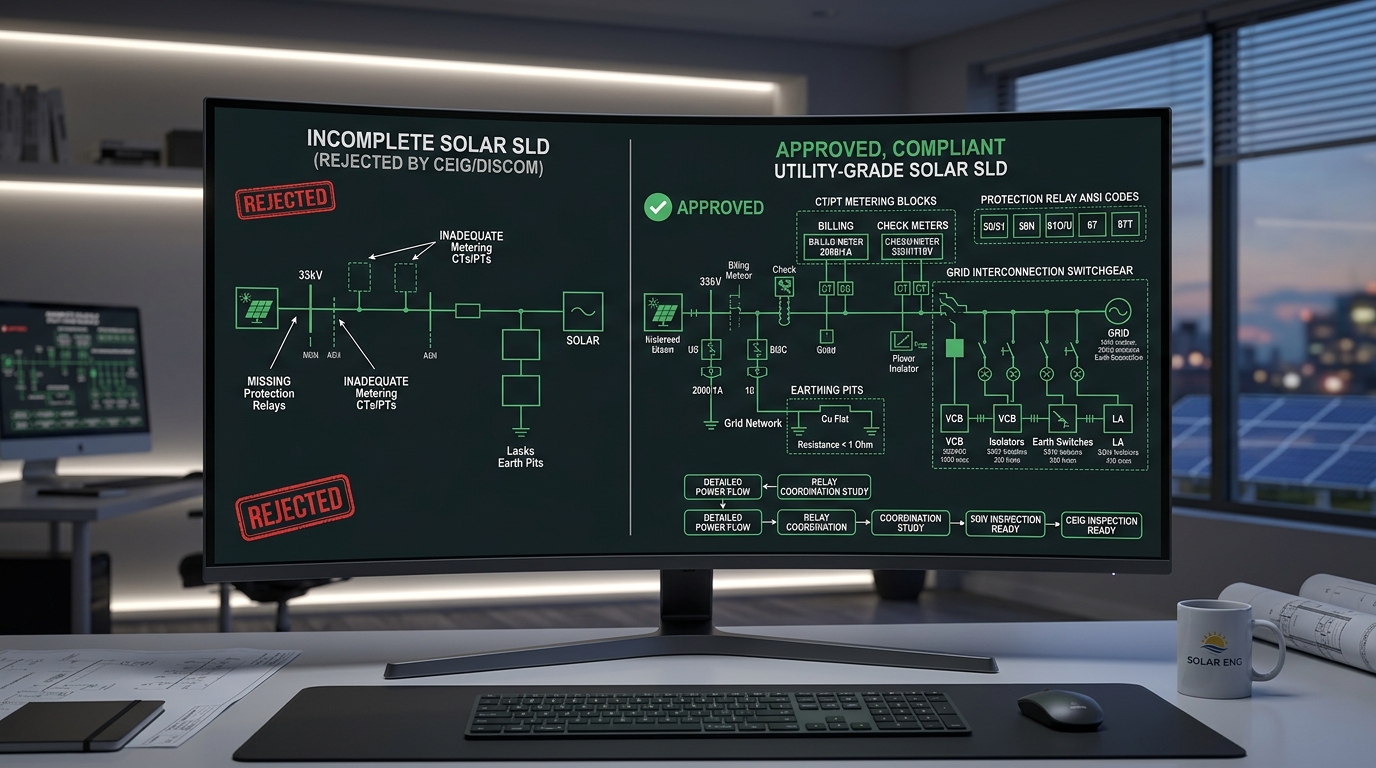
Picture a completed 3 MWp C&I solar plant in Chakan or Sanand. Modules are torqued, string inverters are terminated, and transformers are tested. Yet the breaker stays padlocked open, losing ₹40,000 to ₹85,000 a day in unbilled generation. The culprit is rarely hardware. It is a query letter from the Chief Electrical Inspectorate to Government (CEIG) rejecting a half-baked AutoCAD solar single line diagram (SLD).
Drawings fail because drafting teams treat a statutory approval SLD like a preliminary sales sketch.
What Evaluators Actually Look For in a Solar Single Line Diagram
When inspectors at CEIG or state DISCOMs (MSEDCL, GUVNL, BESCOM, TANGEDCO) review your dossier, they ignore module brochures. They audit fault containment and grid safety. Their job is verifying that your 11 kV or 33 kV feeder cannot back-feed a dead utility line during maintenance or rupture a metering cubicle under fault currents. If an inspector has to guess your fault level or relay ratios, your file gets rejected.
The 5 Missing SLD Details That Trigger Instant Queries
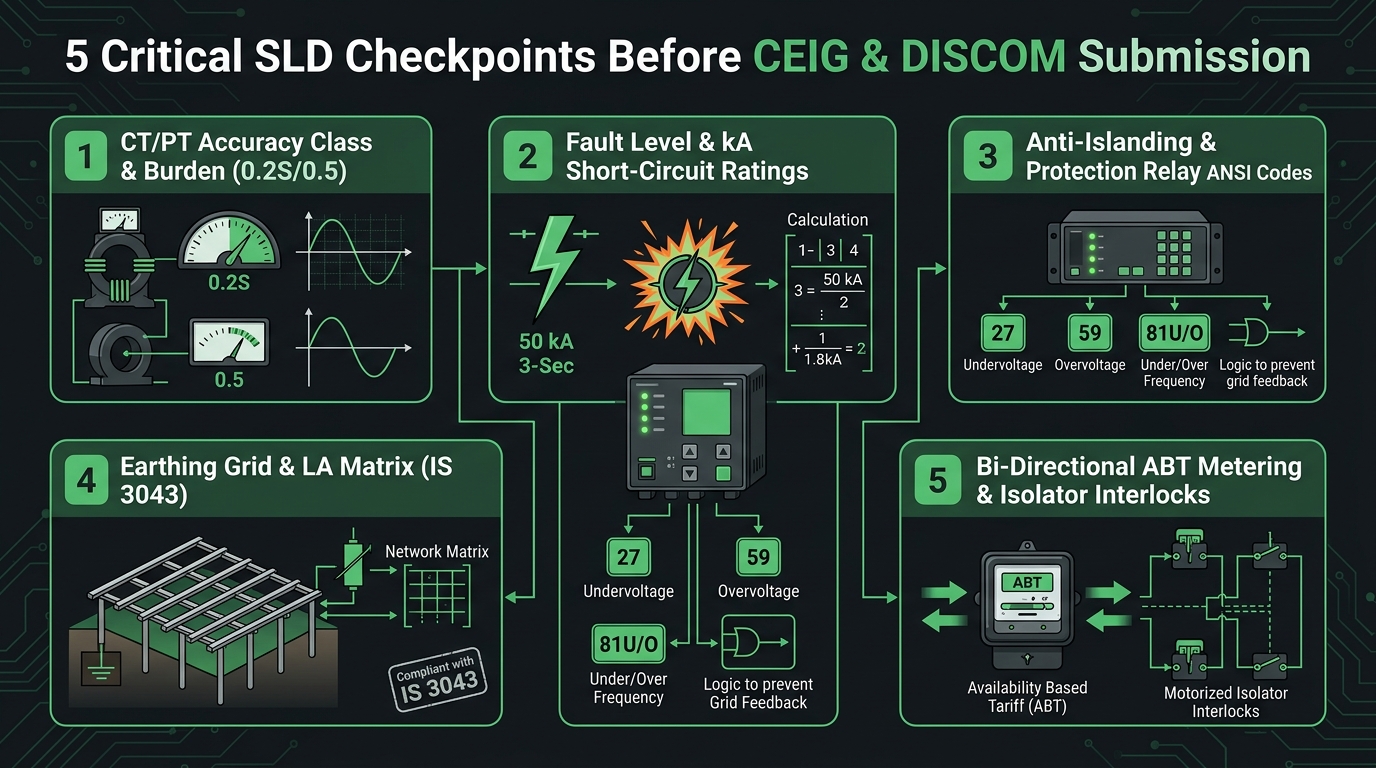
Across our drawing audits, five omissions cause 90% of queries during solar grid integration:
| SLD Parameter | What Draftsmen Draw | What CEIG / DISCOM Requires |
|---|---|---|
| CT / PT Cores | Ratio only (200/5A) |
VA burden (10 VA/15 VA), STC rating, and accuracy class (0.2S for tariff metering vs 5P10 for protection) |
| Breaker kA Rating | 11 kV, 630A VCB |
Short-circuit breaking capacity (25 kA or 31.5 kA for 3 sec) matched to substation fault levels |
| Relay ANSI Codes | "Numerical Relay" | ANSI codes 27, 59, 81O/U, 67, 50/51, and active anti-islanding trip links |
| Breaker Interlocks | Unlinked symbols | Mechanical and electrical interlocks between grid incomers, DG sets, and solar evacuation breakers |
| Earthing Schedule | Single ground icon | Complete IS 3043 solar power plant earthing design schedule with separate DC, body, neutral, and LA pits (50×6 mm GI/Cu) |
Pre-Submission Drawing Audit: How EPCs Cut Approval Cycles by 3 Weeks
Every CEIG query round wastes 15 to 21 days. EPCs avoid this by running an owner's engineer solar drawing audit before submission.
Reconcile your solar power plant design against the utility sanction letter. Match VCB fault ratings to substation kA levels, isolate 0.2S ABT metering cores from 5P10 protection cores, and place lightning arrestors ahead of the GOAB switch.
At V-TECH RENEWABLES, our Design & Engineering team delivers approval-ready SLDs and relay tables across India. Whether you need turnkey Solar EPC execution or independent Quality Assurance drawing audits, fixing these five details clears statutory approvals on the first submission.
Frequently Asked Questions
1. Why does CEIG reject solar single line diagrams even when equipment is standard?
CEIG audits site-specific fault safety. Omitting CT/PT accuracy classes (0.2S vs 5P10), VCB kA ratings, or IS 3043 earthing schedules leaves fault compliance unverified, triggering immediate query letters.
2. Which ANSI protection relay codes must be shown on an 11 kV or 33 kV solar SLD?
DISCOMs and CEA norms require under/over-voltage (27/59), frequency (81O/U), directional overcurrent (67), phase/earth fault (50/51, 50N/51N), and active anti-islanding trip links.
3. How long does CEIG drawing approval take if the SLD is complete on first submission?
Complete SLDs with CT/PT burdens, fault ratings, interlocks, and IS 3043 earthing matrices typically clear CEIG sanction within 7 to 14 working days.
About the Author
Written by the Electrical Engineering Team at V-TECH RENEWABLES, Pune—with 15+ years of experience and 500+ MWp of approved solar PV system designs across India.